

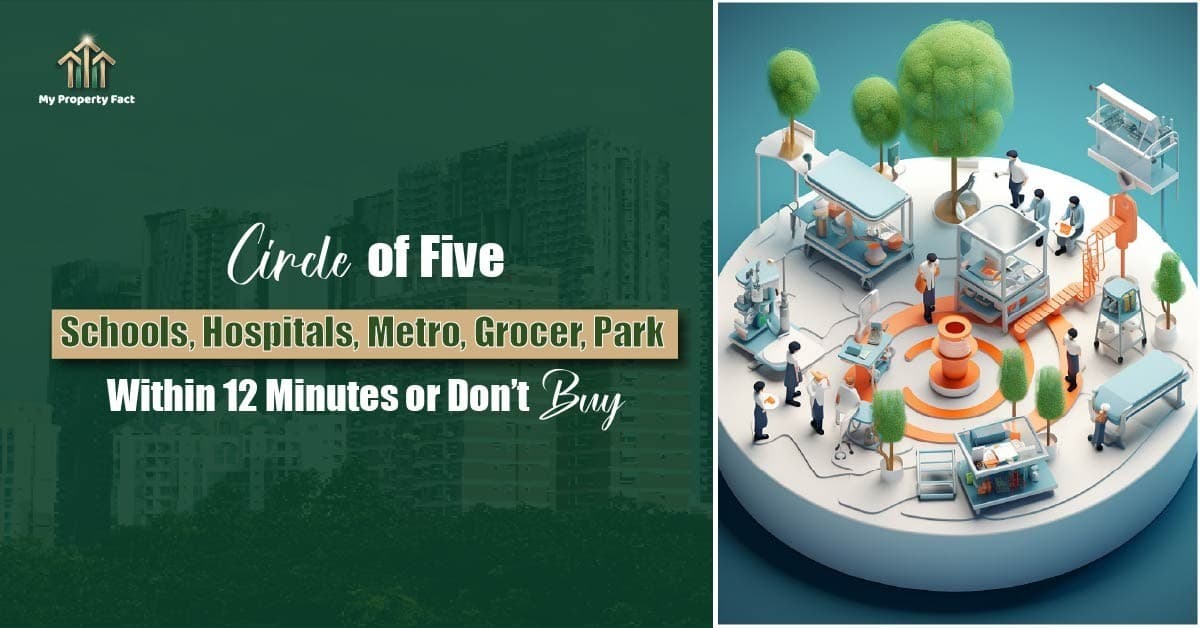
Circle of Five: Schools, Hospitals, Metro, Grocer & Park Within 12 Minutes
If you study how people actually choose homes, you’ll notice something curious. They’ll spend weeks arguing about balcony orientation, vastu alignments, and whether the clubhouse has a squash court they’ll use twice a year. Yet the five things they’ll interact with every single week are barely considered.
We are, as a species, brilliant at evaluating the irrelevant.
So here is a rule that is
almost shockingly effective, so simple it feels like cheating:
If you can’t reach a school, a hospital, a metro station, a grocer, and a
real park within 12 minutes, don’t buy the home.
Not 12-ish. Not 15 on a
good day. A real, lived, stopwatch-tested twelve.
Below that threshold, life feels surprisingly smooth. Above it, entropy takes
over.
This isn’t urban planning. This is behavioural insurance.
Why these five?
Because these are the only amenities where our stated preferences and our revealed preferences match. Everyone says they want gyms and sky lounges. What they actually use are schools, hospitals, transit, groceries, and green pockets.
Each one touches a primal human driver:
- School → routine
- Hospital → survival
- Metro → freedom
- Grocer → habit
- Park → sanity
Forget the brochure. These are the real levers.
Why twelve minutes?
Because human behaviour
changes at certain invisible thresholds.
Below twelve minutes, an errand feels trivial. Above twelve, it quietly becomes
a chore. And unless you have the motivational stamina of a Navy SEAL, chores
pile up, health declines, and daily life becomes a negotiation with your own
laziness.
Twelve minutes is the
margin where convenience becomes momentum.
Thirteen minutes is where convenience becomes an excuse.
It’s extraordinary how many people will choose a home that requires a 25-minute expedition for milk while demanding a gym on the 9th floor to encourage fitness.
You can’t behavioural-science your way out of a bad location.
The depth behind the rule (even though you don’t need it)
1. Frequency beats luxury
A park you visit five times a week matters more to your wellbeing than a rooftop bar you visit twice a year. Yet marketing materials invert this priority because luxury is easier to photograph than sanity.
2. Optionality is undervalued
A metro station isn’t transport. It’s a guarantee that no matter how bad the traffic gets, you still have a workable Plan B. People underestimate how valuable a reliable Plan B is until they don’t have one.
3. Fear is a silent price
A hospital within twelve minutes reduces the tax your brain pays in background anxiety. Your property valuation may not say this explicitly, but your 3 a.m. self absolutely understands it.
4. Time is the one resource that never appreciates
If your home saves you twenty to thirty minutes a day, that’s a compounding engine. Even the world’s best investors can’t beat compounding time at zero risk.
5. These amenities are network effects
Neighbourhoods with a tight Circle of Five attract better tenants, better upkeep, better civic interest, and better demand. Values rise not because the property is attractive, but because the ecosystem is attractive.
This is not urban theory. It is psychology masquerading as geography.
The tell-tale signs of a strong Circle of Five neighbourhood
- You see actual people using the park, not just gardeners manicuring it.
- The grocer stocks blueberries and fresh coriander at all hours because demand is predictable.
- Schools nearby have waitlists, which tells you future rents will never be desperate.
- The metro has a steady crowd even during non-peak hours.
- The hospital has enough footfall to maintain quality but not enough to feel like a railway station.
These are not amenities. These are behavioural indicators.
The Saturday Test (the most honest simulation you can run)
Imagine this:
- Your child needs craft material at short notice.
- You want to pick up fruit before guests arrive.
- You’d like a walk before dinner.
- You have a sudden meeting in the city.
- Someone in the house wakes up feeling dizzy.
If each of these is a 0–12
minute problem, your home will feel like an upgrade every day.
If any of these crosses 15–20 minutes, the home becomes a friction factory.
Friction, by the way, is the biggest destroyer of lifestyle satisfaction. Not size. Not amenities. Not marble thickness. Friction.
Why this rule destroys buyer’s remorse
Most people regret homes not because of features, but because of daily annoyances that accumulate interest. The Circle of Five neutralises 80 percent of those annoyances before they can grow teeth.
Good rules don’t predict the future. They prevent disappointment.
The real insight: The Circle of Five is not about convenience, it’s about resilience
A home inside the Circle of Five is resistant to:
- Economic slowdowns
- Shifts in work patterns
- Educational changes
- Medical emergencies
- Lifestyle inertia
- Rental market volatility
It’s not just a comfortable home. It’s an antifragile investment.
Properties outside this
circle are the first to stagnate and the last to recover.
Properties inside it rarely stay unsold.
Final thought
Every city has its glamour districts and its storybook brochures. But when you zoom into the neighbourhoods that endure across cycles, generations, and tastes, they all look suspiciously similar: they sit inside a tight Circle of Five.
The smartest real estate rule is not the most complex. It's usually the one a practical grandparent could’ve told you.
Schools, hospitals,
metro, grocer, park. Twelve minutes or don’t buy.
It’s astonishing how much wisdom can hide inside a stopwatch.

.png&w=48&q=75 "X (Twitter)")


