

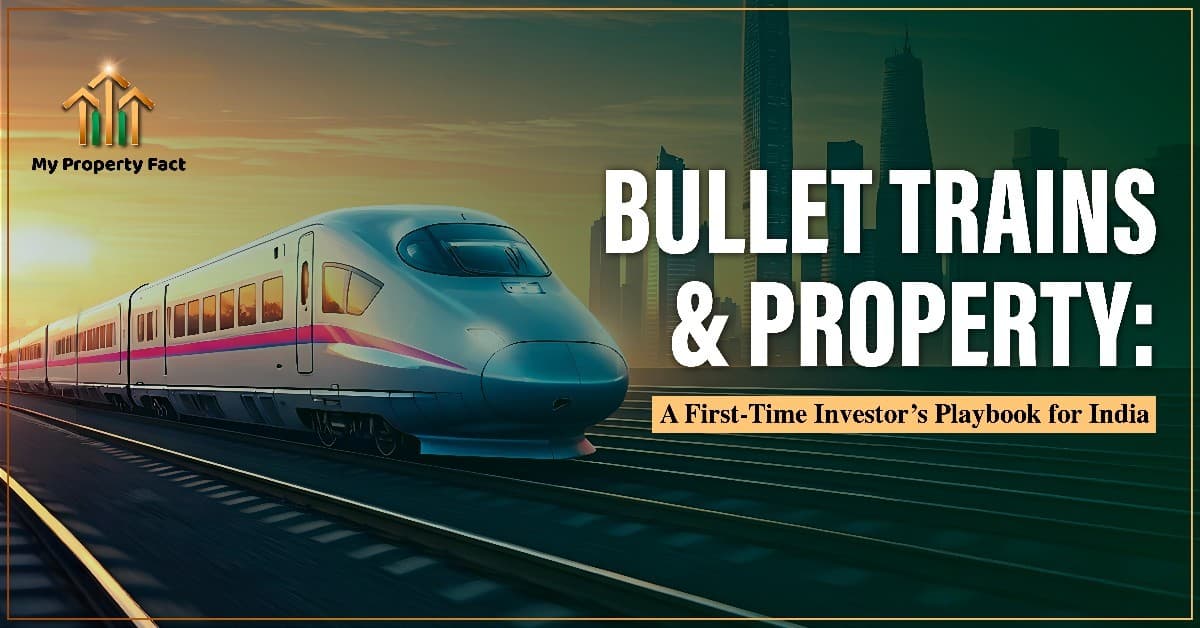
Bullet Trains & Property: A First-Time Investor’s Playbook for India
If you’re buying your
first investment home or your first plot, one idea should be on your radar: time.
When travel times shrink, land values reshuffle. India’s first bullet train
corridor, Mumbai–Ahmedabad High-Speed Rail (MAHSR), is a textbook
example of time compression creating new winners. Here’s a practical,
no-nonsense guide to what will likely change, where the early opportunities
lie, and how to avoid rookie mistakes.
What’s actually coming (and why it matters)
The MAHSR is a 508 km line connecting Mumbai (BKC) ↔ Thane ↔ Virar ↔ Boisar ↔ Vapi ↔ Bilimora ↔ Surat ↔ Bharuch ↔ Vadodara ↔ Anand/Nadiad ↔ Ahmedabad ↔ Sabarmati—12 stations in all. Think of these as future value magnets. (The Metro Rail Guy, NHSRCL)
Government updates in August 2025 reiterated a phased opening plan: Gujarat’s Vapi–Sabarmati stretch is planned for December 2027, with the full corridor targeted for December 2029 (subject to complex-system caveats). Construction has real momentum, NHSRCL reported 300 km of viaducts completed by May 2025, alongside heavy progress on piers and foundations. Translation: we’re beyond drawings; physical assets are rising, and markets usually price that in. (Press Information Bureau, DeshGujarat, NHSRCL, ETInfra.com)
Crucially, the bullet
train isn’t just tracks and trains. The operator (NHSRCL) and cities are
pushing Transit-Oriented Development (TOD) under the SMART (Station
Area Development) program: mixed-use zoning, pedestrian-first streets, and
seamless links to metro, bus, taxi, and autos, especially around 0–800 m
of stations. That planning framework is what turns a station into a new
urban district. (NHSRCL,
The
Financial Express)
How high-speed rail tends to move real estate
Global research is surprisingly consistent:
- Accessibility premium: Properties closest to well-integrated stations typically command higher prices and rents. Meta-reviews and city studies (Europe, China, Japan) show statistically significant uplifts near stations, modest in some places, larger where last-mile transit and walkability are strong. (Mineta Transportation Institute, MDPI)
- Decentralization: Faster trips let people live farther, spend less, and still reach big-city jobs. That often shifts demand outward, from the priciest cores into connected, lower-cost suburbs and tier-2/3 nodes, raising values along the line while relieving pressure at the center. (UCLA Anderson Review)
- Commercial & hospitality clustering: Think satellite offices, co-working, business hotels, and retail in and around station precincts, especially at interchanges where multiple modes meet and footfall is high. Evidence across markets links improved rail accessibility with stronger commercial take-up and higher land values. (Mineta Transportation Institute)
MAHSR: Where the early
action could be
BKC (Mumbai terminus)
A premium, underground station with corporate gravity. Expect hospitality,
retail, and trophy offices to stay hot; residential plays here are
capital-heavy and niche for first-timers, but nearby micro-markets can benefit
through rental demand from commuters and business travelers. (The Metro
Rail Guy)
Thane & Virar
(Maharashtra suburbs)
With SMART-style integration and better last-mile links, these can become value-for-money
rental and end-user markets for Mumbai jobholders who want more space per
rupee. Investor angle: mid-ticket, commuter-friendly apartments near feeder
metro/bus nodes. (NHSRCL)
Boisar, Vapi, Bilimora
(frontier affordability)
If door-to-door times compress as planned, these nodes could see move-out
demand from Mumbai and upgrade demand from Surat/Vapi households.
Entry prices are lower, which helps first-time investors manage risk; just be
picky on last-mile access and neighborhood livability. (The Metro
Rail Guy)
Surat
Already a strong economic base (diamonds/textiles) plus a shortlisted SMART
station. Expect business hotels, branded residences, co-living, and retail
streets to gather around the node. Good soil for rent-yield
strategies if you buy near future pedestrian corridors. (Hindustan Times)
Vadodara, Anand/Nadiad,
Ahmedabad, Sabarmati (Gujarat belt)
With the Gujarat section planned to lead the opening, these hubs are your first
laboratory for measurable price and rent effects. Sabarmati is positioned
as a major interchange/terminal with commercial integration. (Press
Information Bureau)
A simple, repeatable site-selection framework
Draw three rings around the station:
- Ring A: 0–800 m (TOD core).
Target mixed-use streets with active ground floors, plazas, and direct station access. Plays: studio/1-bed rentals, small-format retail (if you’re experienced), and hospitality partnerships. Liquidity is usually strong, but ticket sizes are higher. (NHSRCL) - Ring B: 0.8–2.5 km (walk/feeder belt).
This is often the sweet spot for first-timers: mid-ticket apartments that benefit from connectivity but price in less hype. Look for planned feeder metro/bus stops, safe walkways, and schools/healthcare within 10–15 minutes. Yields can be more attractive than in Ring A. (The Financial Express) - Ring C: 2.5–6 km (value fringe).
Go here only if you have verified last-mile reliability (frequent buses, rapid transit, or proven ride times). Your edge is lower entry cost and the option to buy slightly larger formats that end-users prefer. This ring benefits later in the project timeline. (Mineta Transportation Institute)
Product-market fit matters:
- Near stations (A/B rings), compact, amenitized units rent faster to commuters and business travelers.
- In the fringe (C ring), 2–3 BHKs with good schools and parks attract sticky end-users, often a safer cash-flow bet. (Mineta Transportation Institute)
Milestones to watch (and how markets usually react)
Markets tend to experience repricing waves:
- Civil visibility (viaducts, station boxes up) → early land/flat price firming.
- Systems installation (track, power, signaling) → renewed optimism.
- Trial runs and firm opening dates → last pre-opening bump and rental demand forming.
For MAHSR, we’re already in wave #1–#2 in many sections (e.g., viaduct progress), and public timelines for the Gujarat stretch and full corridor are on record. Align your purchases with observable milestones, not rumours. (NHSRCL, ETInfra.com, Press Information Bureau)
Risk controls for first-time investors
- Don’t buy the brochure, buy the block. Walk the micro-market at night and on weekends. If you can’t reach the site easily without a car, renters won’t either. SMART/TOD documents are useful, but verify what’s funded, not just planned. (NHSRCL)
- Mind the timeline spread. Infrastructure slips happen. Structure your investment so that your carry (EMIs, maintenance) is survivable if opening nudges out by 12–24 months. Govt communications acknowledge complexity, plan for buffers. (Press Information Bureau)
- Last-mile is the kingmaker. HSR without feeder transit = weaker premiums beyond the TOD core. Prioritize nodes/street grids slated for metro/bus integration and pedestrian upgrades. Four stations (Thane, Virar, Surat, and Sabarmati) have been prioritized under SMART; those are good places to begin your shortlist. (Hindustan Times, The Financial Express)
- Speculation vs. fundamentals. If prices have outrun nearby rents and real household incomes, pass. Look for areas where monthly rent covers a healthy slice of EMI and where employment anchors are diversified (not just one industry). Broader research is clear: accessibility lifts values, but the size of the lift depends on integration quality and local economics. (Mineta Transportation Institute, MDPI)
A quick, actionable playbook
- Shortlist 2–3 stations that match your budget and risk appetite (e.g., Surat for rental yield; Thane/Virar for commuter demand; Vapi/Bilimora for affordability). (The Metro Rail Guy)
- Apply the ring test (A/B/C) and visit at peak hours. Score walkability, bus frequency, metro linkages, and safety. (NHSRCL)
- Pick unit types for the likely tenant (executives near A/B; families in C), and run a conservative rent-vs-EMI calculation. (Mineta Transportation Institute)
- Time entries to milestones (e.g., when station structures top out or feeder upgrades break ground). Re-check prices after each visible progress step to avoid overpaying. (NHSRCL)
- Diversify: two smaller units across different nodes often beat one big bet in a single hot spot, especially early in a corridor’s life cycle. (Liquidity > bragging rights.)
Bottom line
Bullet trains don’t merely move people faster; they redraw the real-estate map. With MAHSR, the combination of 12 high-access stations and station-area TOD is set to create new, walkable urban districts, extend Mumbai and Ahmedabad’s commuter sheds, and pull investment into today’s “far” suburbs, provided last-mile links are executed well. For a first-time investor, the winning formula is boring (and that’s good): buy well-located, livable assets near funded infrastructure, price for delays, and let time savings do the heavy lifting. (The Metro Rail Guy, NHSRCL)
If you tell me your budget and a preferred city on the corridor, I’ll sketch a 3-ring shortlist with sample rent/EMI math you can take to the site this week.


.png&w=48&q=75 "X (Twitter)")


